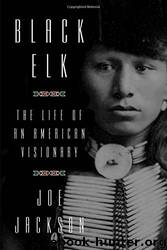
Black Elk: The Life of an American Visionary by Joe Jackson
Author:Joe Jackson
Language: eng
Format: epub
Tags: Biography, History
Publisher: Macmillan
Published: 2016-10-25T04:00:00+00:00
21
“THERE WILL BE A BETTER DAY TO DIE”
That night, a frigid wind blew from the northwest, bringing a light cover of snow. At Wounded Knee, bodies began to freeze. Pools of blood iced over. The snow fell heavier as the night progressed, freezing the dead into grim statuary but softening the angles. Almost all the dead warriors were clustered around Big Foot’s tent and down in the ravine, but the bodies of the women and children were scattered as far as two or three miles from this epicenter. Some still lived and would lie where they’d fallen until burial parties arrived. Most would die of their wounds or the cold; they included some infants, wrapped tight in shawls or sheltered by their mothers’ corpses. Every infant suffered hypothermia, and only one survived. Indian women in camp called her Zitkala-noui, or “Lost Bird.”
How many died at Wounded Knee? The army reported twenty-five soldiers killed and thirty-five wounded, though a 1933 report in the Official Bulletin of National Indian War Veterans said that about fifty coffins were needed for soldier fatalities. One explanation has been noted previously: the army at this time did not include in its casualty lists the deaths of Indian and mixed-blood scouts, and of civilians. One out of every eight soldiers at Wounded Knee was killed or wounded, a high rate in any conflict. The grim line of wagons and ambulances rolled into the Agency at 9:30 that night, escorted by the shocked and sobered survivors. They took the army wounded to the hospital, which soon filled up; thirty-eight wounded Lakotas also brought by the wagons were taken to the Episcopal church, where the Santee Sioux pastor, Thomas Cook, removed the pews and altar and covered the floor with blankets and straw.
Far more Indians died than were ever counted, and the exact number has been debated since the massacre. The final telegrams to Washington would tally 150 Indians killed, 30 wounded or captured; this would be modified in the Indian Office’s final report as 84 men and boys killed, 44 women, and 18 children, for 146 dead. Another 33 were listed as wounded, “many of them fatally.” But this only includes those whose bodies were found at the scene. The women and children later found scattered across the prairie never made it into the reports.
Such numbers do not bear scrutiny for very long. Miles totaled about 200 Indian dead in his report and in a confidential letter lamented that “I have never heard of a more brutal, cold-blooded massacre than that at Wounded Knee.” He described “women with little children on their backs, and small children powder-burned by men being so near as to burn the flesh and clothing with the powder of their guns, and nursing babes with five bullet holes through them.” Nebraska state troops put the Indian dead at 220, while Agent Royer, Dewey Beard, and the Smithsonian’s James Mooney placed it around 300. Today, scholars believe the Seventh Cavalry killed between 270 and 300 of the 400 members of Big Foot’s band, or nearly 75 percent.
Download
This site does not store any files on its server. We only index and link to content provided by other sites. Please contact the content providers to delete copyright contents if any and email us, we'll remove relevant links or contents immediately.
Becoming by Michelle Obama(10033)
Beartown by Fredrik Backman(5768)
The Last Black Unicorn by Tiffany Haddish(5643)
Man's Search for Meaning by Viktor Frankl(4612)
The Book of Joy by Dalai Lama(3996)
The Five People You Meet in Heaven by Mitch Albom(3575)
In a Sunburned Country by Bill Bryson(3548)
The Choice by Edith Eva Eger(3479)
Full Circle by Michael Palin(3455)
The Mamba Mentality by Kobe Bryant(3289)
The Social Psychology of Inequality by Unknown(3039)
Imagine Me by Tahereh Mafi(2972)
Book of Life by Deborah Harkness(2943)
The Checklist Manifesto by Atul Gawande(2863)
Less by Andrew Sean Greer(2701)
A Burst of Light by Audre Lorde(2614)
The Big Twitch by Sean Dooley(2440)
No Room for Small Dreams by Shimon Peres(2376)
Everest the Cruel Way by Joe Tasker(2347)
